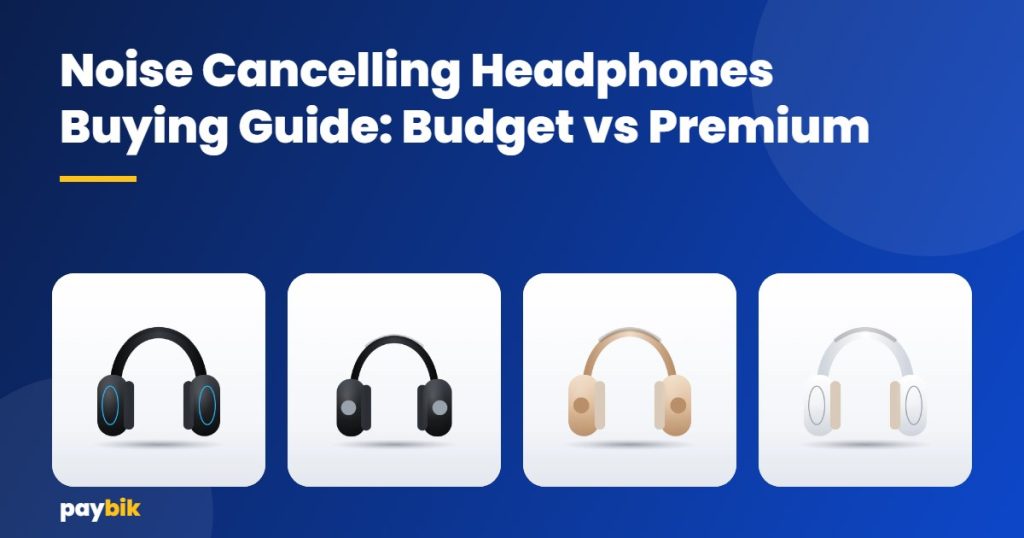
Noise Cancelling Headphones Buying Guide: Budget vs Premium
Five over-ear headphones from Soundcore, Sony, Beats, Bose and Beribes compared on noise cancelling, battery rating and wired use, plus when a speaker fits better.
Put together by the paybik team from published specifications to help you choose before you buy. How we pick
- 1Quick picks
- 2Comparison at a glance
- 3Soundcore Q20i: the budget starting point
- 4Sony WH-CH720N: the lightweight mid-range option
- 5Beats Studio Pro: premium features and three ways to connect
- 6Bose QuietComfort: comfort and quiet for travel
- 7Beribes Over-Ear: low cost, no active cancelling
- 8How to choose noise cancelling headphones
- 9Common mistakes
- 10When a speaker is the better buy
- 11Frequently asked questions
- 12Bottom line
paybik may earn a commission when you buy through links in this article, at no extra cost to you.
This guide compares budget and premium noise cancelling headphones so you can decide how much to spend and what you get for the extra money. It covers five over-ear models from Soundcore, Sony, Beats, Bose and Beribes, then looks at when a portable Bluetooth speaker is the better buy. To be plain about the method: this guide is based on published specifications and on what each brand states about its product, not on hands-on testing.
Quick picks
- Best budget pick with ANC: Soundcore Q20i, with hybrid active noise cancelling, app control and a wired option.
- Best lightweight mid-range pick: Sony WH-CH720N, listed at 192 g with adjustable ambient sound.
- Best premium pick for mixed Apple and Android use: Beats Studio Pro, with USB-C lossless audio and spatial audio.
- Best premium pick for comfort on long trips: Bose QuietComfort, with plush cushions and a cable that works when the battery is flat.
- Best low-cost pair without ANC: Beribes Over-Ear Bluetooth Headphones, a basic wireless pair with a long battery rating and passive isolation only.
For a shorter list focused only on ANC models, see our page on the top noise cancelling picks.
Comparison at a glance
| Model | Tier | Active noise cancelling | Battery as rated by the brand | Best for |
|---|---|---|---|---|
| Beribes Over-Ear | Entry | No, passive isolation only | More than 65 hours | Study, streaming and a spare pair |
| Soundcore Q20i | Budget | Yes, hybrid | 40 hours with ANC on, 60 hours in normal mode | Commuters and students |
| Sony WH-CH720N | Mid-range | Yes | Up to 35 hours | Long sessions where low weight matters |
| Beats Studio Pro | Premium | Yes | Up to 40 hours; check the listing for the figure with ANC on | Lossless and spatial audio, Apple or Android |
| Bose QuietComfort | Premium | Yes, with passive sealing | Up to 24 hours | Frequent flyers who put comfort first |
Soundcore Q20i: the budget starting point
The Soundcore Q20i is the model to look at first if you are searching for budget noise cancelling headphones. It uses hybrid active noise cancelling, which means two internal and two external microphones pick up surrounding sound. The brand says this reduces up to 90 percent of external noise.
Three modes, ANC, Normal and Transparency, are switched in the Soundcore app, which also offers 22 presets and a custom equalizer. The manufacturer rates the battery at 40 hours with ANC on and 60 hours in normal mode, and says a 5-minute charge adds about 4 hours of listening. Two devices can stay connected at once over Bluetooth 5.0, and an AUX cable allows wired listening. The limits are typical of the tier: budget cancelling handles steady hums such as engines better than voices and sudden sounds, and mode switching depends on the app.
Sony WH-CH720N: the lightweight mid-range option
The Sony WH-CH720N is built around low weight. The brand lists it at 192 g and describes it as its lightest wireless noise cancelling headband model. Cancelling is handled by what Sony calls Dual Noise Sensor technology, with two microphones per side, and the Integrated Processor V1.
Instead of a simple on or off switch, the Ambient Sound mode is adjustable, so you choose how much outside sound comes through, and Adaptive Sound Control can change settings to suit your surroundings. The manufacturer rates the battery at up to 35 hours and says 3 minutes of charging gives up to 1 hour of playback. A USB Type-C cable is included. The details we have do not cover wired listening, multi-device connection, a folding design or a carry case. Check the listing for each of those before you buy.
Beats Studio Pro: premium features and three ways to connect
The Beats Studio Pro sits in the premium tier and earns that place mainly through connection options. Besides Bluetooth, it plays lossless audio over USB-C and accepts a standard 3.5mm analog cable. It has active noise cancelling and a Transparency mode, plus spatial audio with personalized dynamic head tracking for supported films and music.
The brand rates the battery at up to 40 hours, and says a 10-minute Fast Fuel charge provides up to 4 hours of playback. One-touch pairing is listed for both Apple and Android devices. The caution is that many of these extras matter only if you actually use lossless sources or spatial audio content. Battery figures for headphones are usually highest with cancelling switched off, so check the listing for the rating with ANC on.
Bose QuietComfort: comfort and quiet for travel
The Bose QuietComfort is designed around long wear. Soft over-ear cushions and a padded headband are paired with electronic cancelling that works together with the physical seal of the ear cups. There are two modes: Quiet applies full cancelling, and Aware lets surrounding sound through for announcements or traffic.
For anyone shopping for noise cancelling headphones for travel, the practical detail is the cable. The included audio cable has an in-line microphone and lets the headphones work without Bluetooth, even when the battery is depleted, which makes it suitable for seat-back entertainment systems. The brand rates the battery at up to 24 hours, with 15 minutes of charging adding up to 2.5 hours. That is a shorter rating than the other ANC models here. The brand name also appears on other QuietComfort versions, so confirm which one the listing shows.
Beribes Over-Ear: low cost, no active cancelling
The Beribes Over-Ear Bluetooth Headphones are included as the baseline. No active noise cancelling is listed, so the ear cups provide passive isolation only. What you get instead is a battery the brand rates at more than 65 hours of playback, six fixed EQ modes chosen on the headphones, dual 40mm drivers, a built-in microphone and a foldable frame listed at 0.38 lb.
A 3.5mm audio cable is included for wired use when the battery is empty, and the listing states a Bluetooth 6.0 chip with connection to two devices at once. These figures are the manufacturer’s own, from a lesser-known brand, and no companion app is mentioned. It suits study, streaming and video calls in quiet places, not blocking engine or office noise.
How to choose noise cancelling headphones
Active noise cancelling uses microphones to measure outside sound and plays an opposing signal to reduce it. Passive isolation is simply the physical blocking done by the ear cushions. Compare on five points.
- ANC strength: brands rarely publish comparable numbers, so use the tier as a guide. Entry and mid-range cancelling deals with steady hums better than voices and sudden sounds, while premium models are generally stronger on aircraft.
- Comfort: weight and padding decide whether you can wear a pair for a full flight or workday. Among these five, Sony publishes the 192 g figure and Bose emphasizes cushioning.
- Battery: compare ratings on the same basis. Soundcore gives separate figures for ANC on and off; other brands give a single “up to” number.
- Codecs and phone ecosystem: a Bluetooth codec is the method used to compress audio between phone and headphones, and both ends must support the same one. The details we have do not list codecs for any of these models, so check the listing if a specific codec matters to you. On ecosystem, Beats lists one-touch pairing for Apple and Android, and Soundcore and Beribes list two-device connection.
- Wired use: a cable is a backup when the battery runs out and the usual way to plug into in-flight screens. Soundcore, Beats, Bose and Beribes all list a wired option. For the Sony, check the listing.
Common mistakes
- Expecting silence: ANC reduces noise, it does not remove it. Voices, crying and sudden clatter get through on any tier.
- Comparing battery numbers without checking the mode: a rating with cancelling off is not comparable to one with it on.
- Paying for features you will not use: lossless playback and spatial audio need supporting services, devices and content.
- Assuming a cable and case are in the box: contents differ by model and listing, so confirm them.
- Buying over-ear headphones for the gym: none of these five lists a water or sweat resistance rating in the details we have. For exercise, see our wireless earbuds guide.
When a speaker is the better buy
Headphones are for private listening in noisy places. If you mostly listen at home, in the yard or with other people, a portable Bluetooth speaker may serve you better.
- Compact and long-lasting: the Anker Soundcore 2 has 12W of output from two drivers and an IPX7 rating, and the brand rates the battery at 24 hours. Two units can be paired for stereo.
- Mid-size cylinder: the JBL Flip 5 is listed as waterproof, and the brand rates the battery at 12 hours. Its PartyBoost feature links several compatible speakers. It is an older generation in its series, so check the listing for the exact IP rating and box contents.
- Large outdoor speaker: the Soundcore Boom 2 is listed at 80W with a dedicated subwoofer, an IPX7 rating, a floatable design and a built-in power bank. The manufacturer rates the battery at up to 24 hours, and notes that playtime varies with volume and content.
As general background, IPX7 means a device is rated to survive immersion in fresh water up to one meter deep for 30 minutes. The X means no dust rating, so take care with sand. Browse all headphones and speakers for the full range.
Frequently asked questions
Are expensive headphones worth it?
It depends on how you listen. Premium models in this guide add things such as USB-C lossless playback, spatial audio, plusher padding and a wired cable with a microphone. Frequent flyers and all-day wearers may find that worth it. For bus rides and open offices, a budget or mid-range ANC pair covers the basics.
What is the difference between active noise cancelling and passive isolation?
Active cancelling counters outside noise electronically and works best on low, steady sounds. Passive isolation is the physical blocking done by the ear cushions. The Beribes pair relies on passive isolation only, while the other four combine both.
Which are the best noise cancelling headphones for travel?
There is no single answer, but look for comfort over many hours, a wired option for in-flight screens and a fast top-up charge. The Bose QuietComfort lists a cable that works with a flat battery, the Beats Studio Pro lists a 3.5mm input, and the Sony WH-CH720N is the lightest by published weight.
Can I use these headphones with a cable?
The Soundcore Q20i, Beats Studio Pro, Bose QuietComfort and Beribes models all list a wired connection. For the Sony WH-CH720N, the details we have mention only a USB Type-C charging cable, so check the listing for wired audio support.
Should I buy headphones or a Bluetooth speaker?
Choose headphones if you need to reduce noise around you or keep your audio private. Choose a speaker if you listen with other people, outdoors or around water, where a waterproof rating matters more than cancelling.
Bottom line
If you want noise cancelling headphones without a premium outlay, the Soundcore Q20i offers hybrid ANC, an app and a long battery rating, and the Sony WH-CH720N is the choice when low weight matters most. Stepping up to the premium tier makes sense for specific reasons: the Beats Studio Pro for lossless and spatial audio across Apple and Android, and the Bose QuietComfort for comfort and a dependable wired fallback on long trips.
The Beribes pair is worth considering only if you do not need active cancelling at all. And if most of your listening is shared or outdoors, one of the three speakers above may be the more useful purchase. Whichever way you go, confirm the exact model, box contents, battery rating and the retailer’s return policy on the listing before you order.